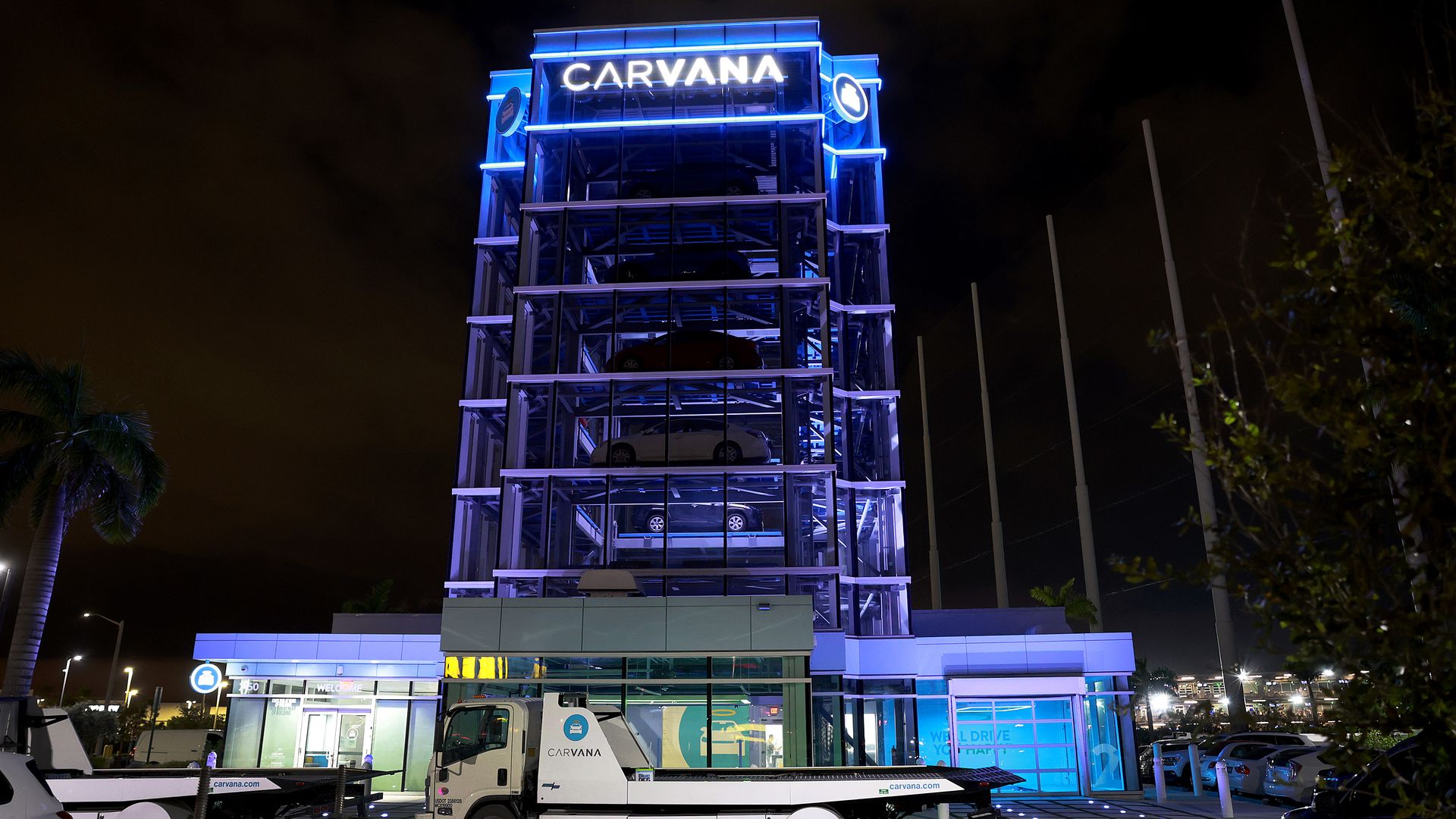
Let me stop for a second so you can think about why this picture represents supply and demand. Got it? No? All right, that’s fine; allow me to explain. Well, you might or might not have heard on the news lately that Carvana, a once wall street darling based in Tempe, Arizona, known for its effortless car vending machines, is struggling to make ends meet and is in hot waters recently with its dire financial situation. Carvana’s financial situation has gotten so bad in recent months that an all-out bankruptcy looms over the business unless new capital is infused into the company. The newly infused capital must be able to mitigate some of the crippling debts that Carvana has assumed over the past two years of rapid growth and company expansion. Do you remember the chip shortage from two years ago? Yes, the chip shortage has everything to do with Carvana’s failure. However, it is also worth noting that there are other economic factors, such as poor economic outlook from institutional investors, recent layoffs affecting retail investors, government fiscal policies, and, most importantly, the sharp decline of demand for cars in the U.S. and globally. This story begins at the very beginning of 2020, at the height of the pandemic when people were forced into a COVID-19 locked down in an effort to curb the spread of the coronavirus. And so because there were not a lot of social gatherings and economic activities, auto dealers at that time saw this trend as an indicator to scale back their business, and that is precisely what they did. However, as we move on into the latter half of 2020, especially towards the end, around December, when the first COVID-19 vaccine came out, people were elated and saw the vaccines as the elixir of the pandemic. Because of this boost in confidence, policymakers also saw this as a critical turning point in the COVID-19 pandemic and that this may be the key forward to restoring the halted economy back to its former glory. Unfortunately, now we know that it is merely an overly optimistic miscalculation because, during the winter months, we saw another surge of cases and an uptick in percent of people suffering from medical complications. Nevertheless, despite the rise of cases and complications, businesses saw an influx of demand for cars, and with that, there was a considerable backlog of the need for semiconductor chips used in producing modern cars. Since the chips were in very high demand and the rate of production simply couldn’t keep up with the demand, used cars began to see massive growth. During those months, used car dealers such as Carvana and CarMax saw record-breaking sales numbers. That, quite frankly, is when they started to massively expand their business by acquiring multiple companies to extend their market reach. However, what they failed to account for is that this demand was simply a short-term hike during the pandemic, nothing more and nothing less.
Responses to the professor or other students:
Response One:
It is genuinely interesting that you have brought up pokemon cards, especially the first-edition Charizard cards. I remember watching a pawn store reality TV show a while back, and someone brought in a whole stack of first-edition pokemon cards with some of them rated as Pristine 10s, which goes for a ton of money nowadays in the collector’s world. Quite frankly, although demand drives up prices, there is another factor in the collector’s world: time. The less of something that is out there, the more value it gets. The thing about these pokemon cards is that they don’t make them anymore. Some of these cards were made back in the 1990s. I’ve linked that pawn star episode below; if you are interested in watching it, I highly recommend watching it. I, for one, learned quite a lot from this video. 😂
Response Two:
Thank you for explaining to us the inner functioning of drugstores. I did not really know about how CVS pharmacy works despiting routinely picking up medications at the nearby storefront. This is definitely handy information to remember next time I visit the store, and it has only contributed to my utmost respect for convenience stores and pharmacy workers. This reminds me of a conversation I had with a friend overseas yesterday. He messaged me last night asking if we could buy Paxlovid here in the states because in the country he resides, there aren’t any, or to put it simply, not available at a reasonable price without paying an arm or a leg. So when I did my research, I found out that this medicine is not only just prescription medication, but it is also only available to people with potentially severe outcomes of COVID-19 or with severe existing comorbidities. This, too, seems to be a heavily regulated industry. Although I do respect the decisions to have a grip over the distribution of this medication in an effort to control price gaugers, I, too, am also worried that being such a heavily regulated medication, Pitzer, the company behind Paxlovid, might have fewer incentives to make more available to accommodate the growing demand.
 Clover's Tree Hollow